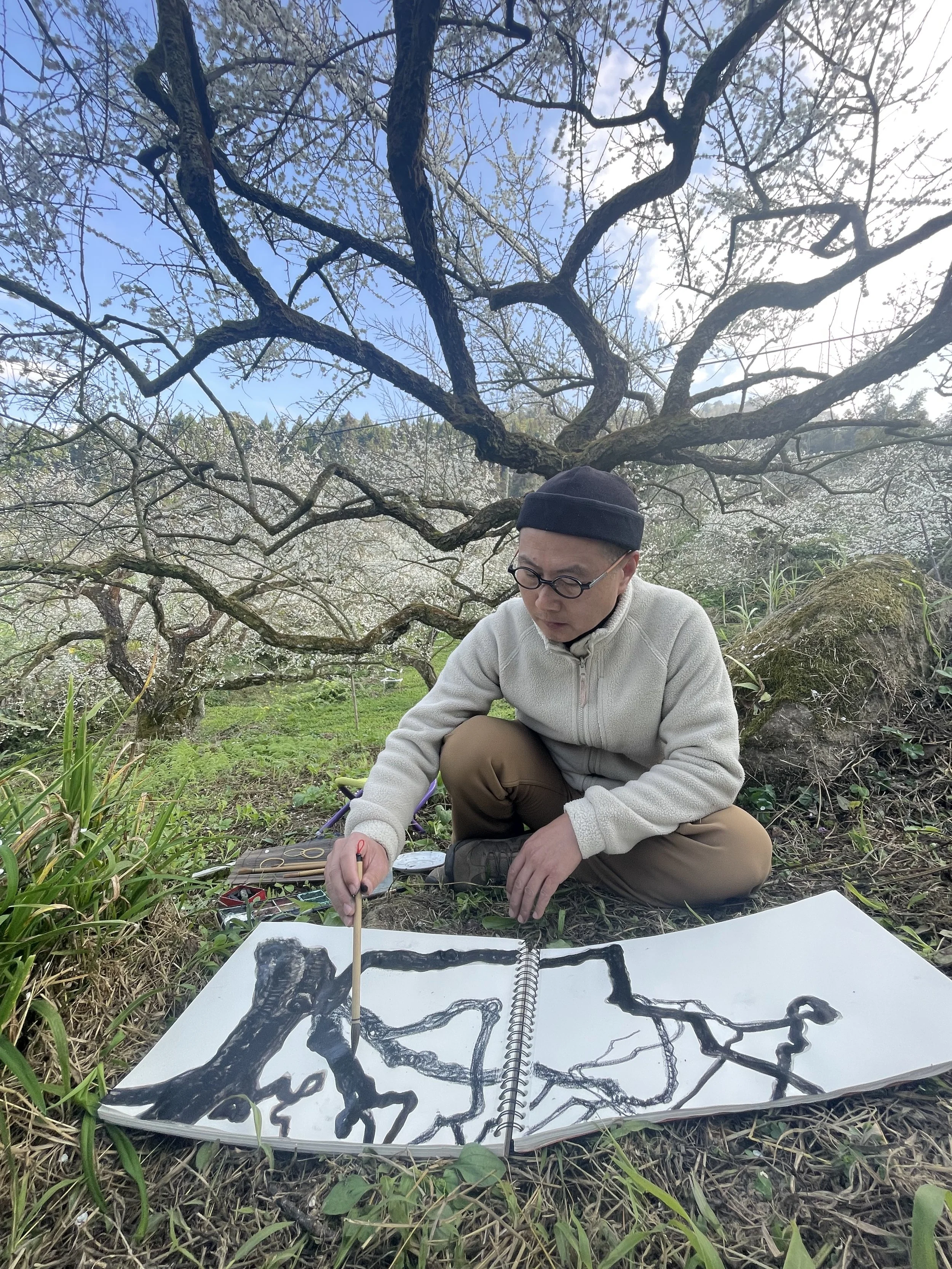
林銓居 Lin Chuan-Chu
林銓居,1963年生於新北市萬里農村。早年長期參與農務,土地、四時節氣與勞動經驗成為其創作根基。1990年畢業於中國文化大學美術系國畫組,翌年前往北京中國藝術研究院研讀藝術史。曾任《典藏》雜誌執行編輯,於九〇年代投入藝術史研究、人物採訪與寫作。2000年旅居芝加哥,修讀 Goddard College 跨領域藝術 MFA,創作由山水延伸至動畫、攝影、行為與裝置,逐步形成以家族、土地、生命與物質消亡為精神核心的跨媒材實踐。2012年後重新聚焦繪畫與寫生,持續行走台灣及世界各地山川,以現場觀看回應自然,發展其當代水墨與風景繪畫語彙。
Lin Chuan-Chu was born in 1963 into a farming family in Wanli, New Taipei City, Taiwan. Years of agricultural labor shaped his enduring relationship with land, seasonal rhythms, and the physical experience of work. He graduated from the Chinese Painting Division of the Department of Fine Arts at Chinese Culture University in 1990, and the following year studied art history at the Chinese National Academy of Arts in Beijing. In the 1990s, he worked as an executive editor at ARTCO magazine, while pursuing art-historical research, artist interviews, and writing.
In 2000, Lin moved to Chicago and studied in the Interdisciplinary Arts MFA program at Goddard College. His practice expanded from landscape painting into animation, photography, performance, and installation, developing a cross-media approach centered on family, land, life, and material dissolution. Since 2012, he has returned his focus to painting and sketching from life, traveling across Taiwan and abroad to observe landscapes firsthand and develop a contemporary vocabulary of ink and landscape painting.
生平
-
林銓居成長於新北市萬里農村,童年時期便開始務農。農活時赤腳行走田埂、使他在四季遞嬗與田間勞動中認識自然。
國中起,他透過校刊編輯與古典文學閱讀,接觸更廣闊的知識世界。進入中國文化大學國畫組後,更將水墨畫視為自我精神養成的實踐。當他在大學時期接觸黃賓虹與余承堯的作品時,尤其受到兩人真實、樸素的氣質吸引,從中找到精神上的相應,也因此確立了將「山水風景」作為藝術創作的主題。
1990年大學畢業後,隨即前往北京研讀藝術史,師承陳綬祥、水天中、郎紹君與薛永年諸先生,浸潤於中國古典文化,並在溥心畬舊居(中國藝術研究院院址)研讀中國藝術史,藉此接觸並見證了當時中國的藝術現場,同時壯遊山川,以實際行走累積對土地與四時景色身體經驗。
他的學習並不限於單一師承,對知識始終保持開放而廣泛的興趣,從萬里的勞動、大學期間文學與水墨的養成,到北京的藝術史研究與遊歷,林銓居在繪畫、閱讀、研究與土地行旅中逐步開展人生的文化起點。
-
1990年代,正值華人藝術出版與文化媒體快速發展的時期。除了持續創作,林銓居也進入了《典藏》雜誌擔任執行編輯,投入藝術史研究、人物採訪與文學寫作,並於2003年開始大學教學工作。
編輯與採訪的經歷,使他有機會直接接觸吳冠中、劉國松、于彭、鄭在東、陳福善、王無邪等華人現當代先鋒藝術家,也讓他親身經歷1990年代中國當代藝術快速發展的過程。求學時期在北京接受的藝術史訓練,加上長期人物採訪所累積的資歷,使他日後研究溥心畬、余承堯等前輩藝術家時,得以從文獻之外取得一手資料,完成多部藝術家傳記。
創作、研究與書寫也由此交織並行,形成林銓居日後所實踐的「文人畫家」身份:既是藝術家,也是作家與研究者。
-
2000年,林銓居隨家人遷居美國芝加哥,異鄉生活使他回望遙遠台灣故鄉的土地、家族與身分認同,也開始反省傳統水墨是否足以承載自身的生命經驗,因此一念,反思、重建並擴延了他的總體藝術觀念。此後十餘年間,他開始從山水繪畫跨越至動畫、攝影、行為、裝置等跨媒材創作,並以家族、母土、生命與死亡作為母題,奠定了日後《家族故事》、《母土》、《晴耕雨讀》與《生命的穀倉》等系列作品的重要基礎。
-
2002年至2012年間,是林銓居創作轉變最劇烈的時期。
從美國生活帶來的文化衝擊,到母親與父親相繼離世,他重新回望家族、農村與自身生命經驗;此外佛教教義對生死與自然的思考也漸漸融入創作,使土地、家族與生命成為這一階段持續發展的創作母題。與此同時,他的媒材從水墨與繪畫擴展至攝影、行為與大型空間裝置。作品先後於智邦藝術基金會、台新藝術基金會、關渡美術館、上海多倫現代美術館、明日美術館與台北當代藝術館發表,逐步形成林銓居此時期以個人生命經驗為出發、跨越不同媒材與展覽空間的創作面貌。
-
歷經藝術史研究、文學書寫、跨媒材創作,以及大型美術館展出之後,2013年起,林銓居將創作重點轉向至風景寫生。大自然蘊藏著無窮的形式美,山勢的起伏、植物的生長、光線與季節的變化,成為藝術家重要的繪畫養分。真正重要的,不是複製前人的筆墨,而是在現場觀看之中,使繪畫重新與土地、時間及生命建立連結。
林銓居自述,繪畫始終是自己最熟悉、也最自由的創作方式。經歷裝置、動畫、攝影與行為藝術之後,再度回歸畫布,使他更清楚理解繪畫所具有的可能性。而這段時間在繪畫上的成長,是過去任何階段都無法取代的。
回望四十餘年的創作歷程,林銓居始終沒有離開土地。從萬里的農村生活出發,歷經北京的藝術史研究、美國的跨文化經驗與不同媒材的探索,他最終回到寫生,以繪畫為方法,行走山川,浸潤於天地之間。
Life
-
Lin Chuan-Chu grew up in the rural landscape of Wanli, New Taipei City, where he began working on the family farm as a child. Walking barefoot along field ridges and laboring through the changing seasons, he came to know nature through direct physical experience.
In junior high school, editing the school magazine and reading classical Chinese literature opened him to a broader intellectual world. After entering the Chinese Painting Division at Chinese Culture University, he came to regard ink painting as a form of personal and spiritual cultivation. During his university years, he encountered the work of Huang Binhong and Yu Cheng-yao. He was particularly drawn to the directness and unadorned quality of their paintings, finding in them a sensibility close to his own and gradually establishing landscape as a central subject in his practice.
After graduating in 1990, Lin went to Beijing to study art history under Chen Shouxiang, Shui Tianzhong, Lang Shaojun, and Xue Yongnian. Immersed in classical Chinese culture, he studied Chinese art history at the Chinese National Academy of Arts, then housed at Prince Gong’s Mansion, formerly associated with Pu Xinyu. The experience also brought him into contact with the contemporary Chinese art scene. At the same time, extensive travel through China’s mountains and landscapes deepened his understanding of land and seasonal change through firsthand observation.
Lin’s education was never confined to a single lineage. His interests remained broad and open, extending across painting, literature, art history, and travel. From agricultural labor in Wanli and his early formation in literature and ink painting to art-historical study and journeys through China, these experiences established the cultural foundations from which his life and practice would unfold.
-
The 1990s marked a period of rapid growth in Chinese-language art publishing and cultural media. Alongside his own practice, Lin joined Diancang magazine as an executive editor, working extensively in art-historical research, artist interviews, and literary writing. He began teaching at the university level in 2003.
His editorial work brought him into direct contact with leading modern and contemporary Chinese artists including Wu Guanzhong, Liu Kuo-sung, Yu Peng, Zheng Zaidong, Luis Chan, and Wucius Wong, while also allowing him to witness the rapid development of contemporary Chinese art during the 1990s. The art-historical training he had received in Beijing, combined with years of interviewing artists and their families, later enabled him to draw on valuable firsthand material in his research on senior artists such as Pu Xinyu and Yu Cheng-yao, resulting in several artist biographies and scholarly publications.
During this period, artmaking, research, and writing became increasingly intertwined, shaping Lin’s identity as a contemporary literati painter: an artist, writer, and researcher whose practice moves across these fields.
-
In 2000, Lin moved with his family to Chicago. Living away from Taiwan prompted him to reconsider the land, family memories, and cultural identity of his homeland, as well as whether traditional ink painting could adequately express his own lived experience. This shift led him to reassess and expand his broader understanding of art.
Over the following decade, his practice moved beyond landscape painting into animation, photography, performance, and installation. Family, homeland, life, and death emerged as central themes, laying the groundwork for later bodies of work including Family Stories, Motherland, Rice for Thoughts, and The Barn of My Life.
-
The decade from 2002 to 2012 marked one of the most transformative periods in Lin’s practice.
Following the cultural dislocation of his years in the United States and the successive deaths of his mother and father, he turned increasingly toward family history, rural life, and his own experience of mortality. Buddhist reflections on life, death, and nature also gradually entered his work, while land, family, and life became recurring subjects.
At the same time, his practice expanded from ink and painting into photography, performance, and large-scale installation. His work was presented at institutions including the Accton Arts Foundation, Taishin Bank Foundation for Arts and Culture, Kuandu Museum of Fine Arts, Shanghai Duolun Museum of Modern Art, Museum of Tomorrow, and Museum of Contemporary Art Taipei. Across these projects, Lin developed a cross-media practice grounded in personal experience while responding to increasingly complex exhibition spaces.
-
After decades of art-historical research, literary writing, cross-media experimentation, and large-scale museum exhibitions, Lin gradually shifted his focus toward landscape sketching from 2013 onward. For him, nature contains an inexhaustible formal richness: the contours of mountains, the growth of plants, changing light, and seasonal rhythms all provide essential material for painting. What matters is not the reproduction of inherited brushwork, but sustained observation on site, through which painting can reconnect with land, time, and life.
Lin has described painting as the medium in which he feels most fluent and free. After working across installation, animation, photography, and performance, his return to the canvas allowed him to recognize the possibilities of painting with renewed clarity. He considers the development of his painting during this period to be unlike any previous stage of his career.
Looking back over more than four decades of practice, Lin has never moved far from the land. From his rural upbringing in Wanli to art-historical study in Beijing, cross-cultural experience in the United States, and years of experimentation across media, he ultimately returned to sketching from life. Painting has become a way of moving through mountains and landscapes, immersing himself in the natural world.